Rollingwood sits on flat, walkable lots under a heavy live oak canopy, which means the roof is read from the sidewalk and lives under trees at the same time.
01
From ranch shingle to a rebuilt roofline
The Hatley brothers laid out Rollingwood in the 1950s and 1960s, and almost every street still carries a family or friend's name. Nixon Drive, Hatley Drive, Pleasant Drive, Riley Road and Vale Street were built out with single-story ranch homes, and most of those roofs were composition shingle.
Since the mid-2010s block after block has been rebuilt. A new two-story custom gets an architect-specified roof, and a kept ranch house usually gets a better one than it started with. Daniel and Will work on both, and the questions are different. One is about matching a plan set. The other is about what the existing house can carry and what will look right beside it.
02
Standing seam on a street-facing roof
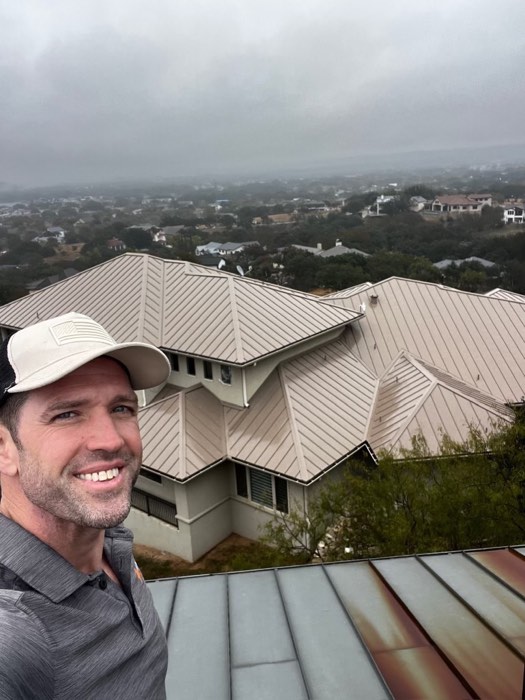
Rollingwood lots are flat and close to the street, so the roof is seen head on rather than from a canyon below. Panel width, seam spacing, ridge and eave details, and the way the metal meets stone or stucco all land at eye level. It is worth drawing the panel layout before ordering rather than letting the crew improvise at the ridge.
Open lots without canopy take full afternoon sun on the west and south planes. A reflective metal roof genuinely runs cooler up there, and color choice is part of that. Look at large finish samples outdoors, on the house, at the hour you are usually home.
03
Slate, synthetic, and impact-rated composite
Hail is the reason many Rollingwood roofs get replaced. The September 2023 storm moved through this part of Travis County, and hail has come back in the springs since. Owners who have been through a claim tend to ask about Class 4 impact-rated products, and that is a fair question to bring to the first conversation along with what your carrier says about them.
Natural slate gives a rebuilt house real mineral depth and needs a structural look before anyone quotes it. Synthetic slate and shake carry similar texture at a different weight. Judge them by edge thickness, color blend, and how the pattern repeats across a whole plane, not by a single sample.
04
Oaks, tight lots, and city permits
The canopy is why people love these streets and why roofs here need attention. Limbs abrade panels, leaves pack into valleys and behind chimneys, and shaded north slopes hold organic growth. Drainage paths should be clear and reachable, and tree work near the roof has to respect oak wilt season.
A quarter-acre lot with neighbors close on both sides changes how the job runs. Delivery, staging, tree protection, and daily cleanup are planned before the tear-off starts. Rollingwood has no master HOA. The city itself handles permits, inspections and drainage requirements, so that is who the paperwork goes through.